![]() |
Fay Sampson | |||||||
|
About the Author
Welcome! The best way for an author to introduce herself is through her books. There are pages for the different things I write. Find Out More links will give you extra details about a book, extracts to read and my thoughts about writing it. Meanwhile, here's the latest news:
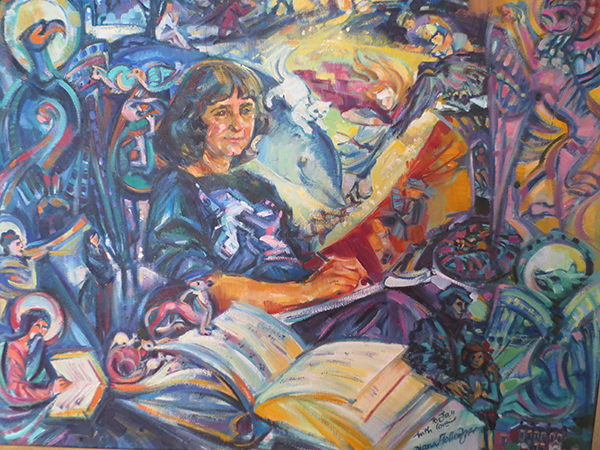
** Lion Hudson have closed their children's fiction list. Sadly, The Sorcerer's Fire, third in the Sorcerer trilogy, will not now be published.** ** Literary agents Pollinger Ltd.are representing me for my latest teenage SF novel, Spider-She, and for In the Blood, a mystery for adults about a woman researching her family history who finds out more than she wanted to.www.pollingerltd.com Enquiries to them about rights to my backlist. ** The Portrait Forget the author photograph. The author portrait is much more fun. When Diana Golledge was asked to paint this, the great thing was that she knew my books as well as me. Diana often paints jazz musicians in performance. But how do you show a writer at work? At first she thought of posing me at my computer. But an author's most important work takes place long before she is ready for the keyboard - in the imagination. So this is what she did:
She has filled the painting with images from my books or things which have inspired me. Can you find the white cat Pangur Ban riding the dolphin Arthmael? Or Edie and her father, from A Free Man on Sunday? Or Taliesin searching through the forest, from the Tintagel novels? In the corners you will see the symbols of the Gospel writers from ancient books: the eagle of St John, the lion of St Mark and the bull of St Luke from the Celtic Book of Kells, and St Matthew writing his gospel from the Anglo-Saxon Lindisfarne Gospels. But for the moment, I am not writing about any of these. My hand is poised over the page as I do the writer's most important work - day-dreaming. Advice to Writers I was a teacher before I became a professional writer. I love both activities. For many years, I divided my time between them. I have enjoyed teaching creative writing classes. It has been a particular pleasure to help other writers achieve publication, especially one who won the Kathleen Fidler Award for an unpublished first children's novel. I am now an editor for The Writers' Workshop, a writing consultancy which advises would-be novelists how to improve their books and, if they reach publishable standard, recommends them to agents. A distinguishing feature of The Writers Workshop is the offer of follow-up after the initial report, so that the client can discuss possible revision with the editor. I have enjoyed working in this way with new authors aged from 15 to 75. Some of them come back for a second opinion when they have rewritten the book.
The first book I can remember is The Water Babies. During the blitz on Plymouth, I and my evacuee cousins caught chicken-pox. We couldn't go out to the shelter in the garden during air-raids. So we crowded into the cupboard under the stairs and my mother read to us. I earned my first money for writing at the age of nine, with a prize-winning story about the birth of the Co-operative movement. But the grammar school I went to gave me the impression that all writers were famous and dead. Since I was neither, it didn't occur to me that I could be a writer too. Instead, I took a degree in mathematics at the University College of the South-West, now Exeter University, and became a teacher. Mathematics, like imaginative fiction, is a game of asking 'What if?' and working out the consequences. I married to another teacher, Jack Priestley, and went to Northern Rhodesia, running the college library, having babies and celebrating the country's independence as Zambia. Back in Devon, I wondered what to do when my children started school and Jack said 'Write'. It took five years and five books before I broke into print with F.67, a children's novel in which British children become refugees in an African country. Since then, I have had over twenty children's books published, a growing number of novels for adults and non-fiction books, as well as short stories. The children's books range from historical fantasy to near-future science fiction, with funny contemporary stories on the way. The novels for adults are based on history or myths and legends. I now live with my husband in a sixteenth-century cottage on a hill outside Tedburn St Mary in Devon. From my study window I look out over the village to Dartmoor. Place is very important to me. I often write with a map spread out beside me. I use my maiden name, Sampson, for writing because it's a strongly West Country name. It is also the name of a Celtic saint, which is just right for someone who loves writing about Celtic history. Have Any of Your Books Won Prizes? The Watch on Patterick Fell won the Barco de Vapor Award, with sale world-wide of over 100,000 copies. It's a near future thriller, about a nuclear waste plant. I am particularly fond of three which were all short-listed for the Guardian Children's Fiction Prize. Pangur Ban, and the five books which follow it, are fantasies set in Celtic times. I love both fantasy and Celtic culture, so I had great fun writing these. Chris and the Dragon is a funny book about a school nativity play where everything goes wrong. A Free Man on Sunday takes two imaginary children on the real-life Kinder Scout Trespass, when people were determined to climb to the top of a Derbyshire Peak, even though walking there was forbidden. I went on a 50th anniversary reconstruction of that walk and met people who had actually done it, including Benny Rothman who went to prison for it. Several have won South West Arts Literary Awards, and many have been listed in Children's Books of the Year. What Is Your Favourite Book? A lot of brilliant children's books were written after I grew up. They still make as good reading as many novels on the adult list. I particularly enjoy fantasy, like those of Alan Garner, Ursula Le Guin and Madeleine L'Engle. One book that meant a lot to me was Mollie Hunter's A Sound of Chariots, because it is so like my own growing-up. Because there were far fewer children's books around, I moved on early to other novels. First there were rip-roaring adventures, like The Three Musketeers. Then Dickens. I had taste for tragedy, relishing the death of little Paul in Dombey and Son. My favourite for a long time was Les Miserables. As you can see, I didn't have much early acquaintance with modern literature. More recent delights have been Toni Morrison's Beloved, Barbara Kingsolver's The Poisonwood Bible, and the marvellous, over-the-top prose of Mervyn Peake's Gormenghast trilogy.
I've recently become addicted to family history. I enjoy researching from early documents, uncovering the human story hidden beneath a few sparse facts, and writing it up in an interesting way to share with the rest of the family. I am lucky that half my ancestors come from Devon, so I have the records on my doorstep. The Kent side are more difficult to follow up, but I've turned up some wonderful stories of boatmen who risked their lives to save ships and crews from the infamous shoals out from Deal. I also belong to the lively Mint Methodist Church in Exeter. We have a great time, talking far into the night, walking together, looking for ways to serve the local community, as well as worshipping on Sundays . I belong to the Society of Authors, the West Country Writers' Association, and the Association of Christian Writers. As an author, I enjoy working alone, making my own timetable and deciding writing projects for myself. But I also need to share the joys and frustrations of this solitary occupation with others. We share valuable information about the publishing scene and opportunities for writers, as well as improving our professional standards. Do You Do Talks? I am also interested in the way Good and Evil are represented in fantasy, and the different ways in which Good wins. I recently did an MA on the way writers image the Good - much harder than inventing the baddies! Research for my novels has got me hooked on the Celts and the way Celtic Christianity developed in the British Isles after the Romans left - starting about the time of Arthur. There are wonderful stories of our local saints. I have been a creative writing
tutor, a Writer in Residence, and Writer in the Community. I'll talk about
writing to anyone who wants to listen, children and adults, any size group.
[ About me ] [ Children's Fiction ] [ Adult Fiction ] [ Non-Fiction ] [ Contact Me] site by www.wordpooldesign.co.uk |
|